St.Michael, Prince of Angels


From Mary's Blog:

"During the summer just past, I was rudely awoken one night by a strong stench of burning. The air around my bed seemed heavy and thick with particles of scorched earth. In my sleepiness, I thought that someone had left a pot of earth-encrusted potatoes on the boil too long and that their muddy skins were now burning. But as I tried to move from bed, the smell of earth-on-fire came at me with a violent power that pushed me backwards and I wondered how I could even raise my voice to cry out that something was on fire. Then the ferocity of the stench struck me as not being of a natural origin and I realized that it was a variety of demonic attack and my soul shrieked, HOLY MICHAEL, PRAY FOR ME . . ."

Read more at Mary's Blog >>

An Angel in Chattanooga?


Photo by Fabrizio Rinaldi (CC BY-NC-ND 2.0)

"Was it . . . an angel?

One of the most incredible accounts I’ve heard involved a Christian chemist named Vincent Tan Ban Soon, who emigrated from Singapore. He was working in a laboratory late the night of March 25, 1993, this in Tennessee, and about 1:30 a.m., as he readied to leave, he happened to look out the door and spot a man standing next to his car, on the passenger side.

It was a tough part of town, known for its crime . . ."


Read more at SpiritDaily.com>>

St. John Henry Newman and the Angels


Newly canonized Cardinal John Henry Newman had an extraordinary devotion to the holy angels. In Sermon Notes he wrote:

“Many wonderful things in this world, but an angel more wonderful than all. If a creature so wonderful, what the Creator?”

In 1853, he wrote a beautiful poem to his guardian angel. Please take a minute to read it, with a prayerful attitude if possible. Your angel will be glad you did.


“Guardian Angel”

MY oldest friend, mine from the hour
When first I drew my breath;
My faithful friend, that shall be mine,
Unfailing, till my death;

No beating heart in holy prayer,
No faith, inform’d aright,
Gave me to Joseph’s tutelage,
Or Michael’s conquering might.

Nor patron Saint, nor Mary’s love,
The dearest and the best,
Has known my being, as thou hast known,
And blest, as thou hast blest.

Thou wast my sponsor at the font;
And thou, each budding year,
Didst whisper elements of truth
Into my childish ear.

And when, ere boyhood yet was gone,
My rebel spirit fell,
Ah! thou didst see, and shudder too,
Yet bear each deed of Hell.

And then in turn, when judgments came,
And scared me back again,
Thy quick soft breath was near to soothe
And hallow every pain.

Oh! who of all thy toils and cares
Can tell the tale complete,
To place me under Mary’s smile,
And Peter’s royal feet!

And thou wilt hang about my bed,
When life is ebbing low;
Of doubt, impatience, and of gloom,
The jealous sleepless foe.

Mine, when I stand before the Judge;
And mine, if spared to stay
Within the golden furnace, till
My sin is burn’d away.

And mine, O Brother of my soul,
When my release shall come;
Thy gentle arms shall lift me then,
Thy wings shall waft me home.

(The Oratory, 1853).


St. Apollonia (check out the pincers!)


Creative Commons license CC BY 4.0 

St. Apollonia

The Martyrology reads: "At Alexandria the holy virgin Apollonia—under the Emperor Decius (249-251) her teeth were beaten out; then the executioners built and lit a funeral pyre, and threatened to burn her alive unless she would repeat their blasphemies. After some reflection she suddenly tore herself loose from her tormentors and threw herself into the flames. The fire of the Holy Spirit that glowed within her was more intense than the burning pyre. Her executioners were astounded to see a weak woman willingly embracing death with such determination before they were ready to carry out their threats."

The saint was already well on in years. An account of St. Apollonia's martyrdom was written by Bishop Dionysius of Alexandria (died 265), a contemporary. She is honored as the patroness against toothache.

Apollonia, it might seem, committed suicide. Her act was used by the ancients as proof that it is permitted to escape dishonor or persecution through voluntary death. But the most authoritative moralists, including Saint Augustine, declare that even in such cases suicide is not permitted, and seek to justify Apollonia's heroic act by assuming that she acted according to a special mandate from God; without such a divine injunction no one is allowed to follow her example. The saints are not to be imitated on every point.
— Excerpted from The Church's Year of Grace, Pius Parsch

Patron: Dentists, tooth disease, toothache.

Symbols: Deaconess holding a set of pincers which often holds a tooth; gilded tooth; pincers grabbing a tooth; pincers; tooth and a palm branch; tooth; woman wearing a golden tooth on a chain.

Things to Do:
  • Pray to St. Apollonia for a courageous and holy death. The elderly especially may beseech her to strengthen their faith as they weaken and approach death.

St. John Bosco's Guardian Angel Advice


"Take courage and pray; your guardian angel will also pray for you, and your prayers will be answered. Pray to your guardian angel. Invoke his aid if you should find yourself in any serious danger of body or soul, and I assure you that he will help and protect you."

St. John Bosco and the Big Gray Dog


On various occasions throughout his life, St. John Bosco found himself aided by a mysterious, yet gentle and loyal, large gray dog. The dog would appear unbidden when St. John was passing through dangerous neighborhoods, traveling on foot through the dark countryside, or, most famously, once when attacked by thugs. (The dog chased the thugs away after giving them a good scare with his not-so-little teeth.) St. John called his intermittent companion Il Grigio, Italian for "The Gray One."

A mysteriously as he appeared, the dog would trot away after accomplishing his duty. Not once did St. John ever see the dog take food or water. And on at least one occasion, the dog somehow disappeared from a cottage in which all the doors and windows were shut.

St. John had no doubt as to the origin of his furry friend: "It sounds ridiculous to call him an angel, yet he is no ordinary dog." Indeed, the saint firmly believed that had it not been for the big gray dog, his work would have been severely hindered, if not stopped altogether.

John Bosco, of course, went on to institute and organize the Salesians, a religious order for men and women under the patronage of St. Francis de Sales. Il Grigio reportedly retained a fondness for the Salesians long after John Bosco left the world. Between 1893 and 1930, sisters of the Salesian order testified that they had received the gray dog's protection on at least three separate occasions.

(A summary of information from Partners in Holiness: Guardian Angels in the Lives of the Saints)


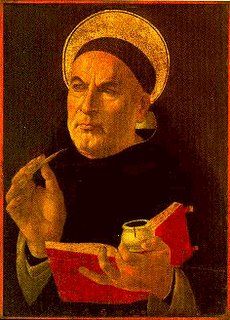
Aquinas on the Angels


Thomas Aquinas was known as, among other things, the "Angelic Doctor.” He wrote extensively about the nature and mission of the angels in his masterpiece, The Summa Theologica, devoting a substantial part of his massive tome to them.

In keeping with the nature of this blog (i.e., easy to read and digest), I thought I'd post a "Top Ten List" of some of St. Thomas' points about the angels from the Summa.

These tidbits aren't arranged in any particular order, nor do they purport in any way to adequately represent the whole of St. Thomas's teachings on the angels. Nonetheless, I think there's enough here for us mere mortals to ponder and appreciate for quite some time And if the spirit should move you to further scholarship, you can read the good Doctor's entire discussion of celestial beings at the Christian Classics Ethereal Library. 

So, here we go:

1.  The angels were created in heaven. And it is fitting that creatures of the most perfect nature should be created in the most noble place.

2.  Angels were created in grace, and by using this grace in their first act of charity (which is the friendship and love of God) they merited the beatific vision and heavenly beatitude.

3.  God gives the angels their knowledge of things when he brings them into existence . . .Each receives what is fitting and necessary for its status and the service it is to render, and therefore some angels know more than others.

4.  Angels manifest knowledge to one another, and to this extent they "speak" to one another. But the speech of angels is not a matter of sounds or of uttered words. The speech of angels is a direct communication of knowledge from spirit to spirit.

5.  The faithful angels are a greater multitude than the fallen angels. For sin is contrary to the natural order.

6.  Angels, good or bad, can do wonderful things, but only such as lie within the power of angelic nature, and a miracle surpasses the powers of all created natures.

7.  Superior rules inferior; hence angels rule the bodily world. St. Gregory says that in this visible world nothing occurs without the agency of invisible creatures.

8.  God sends angels to minister to his purposes among bodily creatures . . . Angels sent in the external ministry are those whose names indicate some kind of administrative or executive office. These are, in descending rank, Virtues, Powers, Principalities, Archangels, Angels.

9.  Each human being, without exception, has a guardian angel . . . In heaven a man will have an angel companion to reign with him, but not a guardian; no guardian is needed when the guarded journey has been successfully completed. In hell, each man will have a fallen angel to punish him.

10.  An angel can illume the thought and mind of man by strengthening the power of vision, and by bringing within his reach some truth which the angel himself contemplates.


(The above translation and wording is courtesy of A Tour of the Summa by Msgr. Paul J. Glenn, Tan Books and Publishers.)


Feast of St. Francis de Sales


"Never be in a hurry; do everything quietly and in a calm spirit. Do not lose your inner peace for anything whatsoever, even if your whole world seems upset." St Francis de Sales

Mother Teresa's Express Novena


Mother Teresa was known for many things, not the least of which was her intense devotion to Mary. Rarely was she seen without a rosary woven around her fingers, Miraculous Medals at the ready to pass out to friends and strangers, and a prayer on her lips in praise or petition. Many times this prayer was the Memorare, one of Mother Teresa’s favorite invocations to the Blessed Virgin. A popular story about Mother Teresa is how, when faced with a seemingly insurmountable obstacle, she immediately turned to Mary for help by praying an “express novena” of nine Memorares. And then a tenth in thanksgiving for favors received, such was her faith and trust.

Did it work? Well, those who worked with Mother Teresa were constantly in awe of how she seemed to always get what she wanted one way or another. Whether it was by appearing in person at the residence of a rich benefactor, influencing a powerful leader with carefully chosen words, or storming heaven with her prayers, Mother Teresa didn’t take no for an answer.

When I first heard about the express novena (also known as the “emergency novena”), I was intrigued enough to search the Web for stories about it. What I found was remarkable, and I urge you, dear readers, to do the same. There are countless testimonies out there that speak of the power of this devotion. And I am happy to say that I now count myself as a member of that camp. About a year ago I faced a personal crisis that led me to Mother Teresa’s emergency novena. I prayed it in my car on a cold February morning with as much fervor as I could muster given my depressed state of mind. Long story short, my crisis passed and my cloud lifted. While skeptics could claim it would have with or without the novena, I have no doubt our Mother in Heaven was looking out for me. Twice more this year I have had to turn to the novena for help. And twice more Mary has come to my aid. If anyone asks me if Mother Teresa’s express novena works, I will unequivocally say yes.

The Memorare is a beautiful prayer usually accredited to St. Bernard of Clairvaux, but its origins are actually unknown. The first manuscript of the Memorare appeared in 1489 as part of a longer prayer. It was popularized in the 17th century by a French cleric, Fr. Claude Bernard (perhaps the similarity in names is why it’s associated with St. Bernard), who taught it as part of his ministry to hospitals and prisons.

Regardless of who wrote it or where it came from, the Memorare is a treasure of our Catholic faith and should be taught to every child as early as possible. With child-like confidence let us return to it in our time of need.


The Memorare Express Novena

State your intention and recite the Memorare nine times.
Remember, O most gracious Virgin Mary, that never was it known that anyone who fled to thy protection, implored thy help or sought thy intercession was left unaided. Inspired by this confidence, I fly unto thee, O Virgin of virgins, my Mother. To thee do I come, before thee I stand, sinful and sorrowful. O Mother of the Word Incarnate, despise not my petitions, but in thy mercy hear and answer me. Amen.